

Authors: Maxime Montaru, Nicolas Guillet, Yann Tanguy, Léandro Cassarino (CEA)
Battery Assessment in Reverse Logistics: A Crucial Step before Reuse, Repair, Repurposing, or Recycling
Reverse logistics for end-of-first-life (EoFL) electric vehicle (EV) batteries face a fundamental challenge: the heterogeneity of residual performance among retired packs. While batteries may appear identical externally, their residual value and safety status can varydramatically - particularly due to differences in operating history, usage patterns, or prior incidents. Without systematic assessment, this variability introduces uncertainty, inefficiency, and safety risks into recovery processes.
The Role of Battery Assessment: Maximising the Residual Value
Battery assessment is an essential step of reverse logistics, enabling data-driven decisions by evaluating key parameters such as specific measurements (electrical and physical), and usage history (e.g. charge/discharge cycles, thermal exposure, incident records). This assessment should provide relevant information on the following points:
- Value-recovery pathways: Optimal routing toward reuse, repair, repurposing in second-life applications, or recycling.
- Handling/packaging: Identification of unstable units requiring isolation (e.g. damaged or thermally compromised modules).
- Transport classification: Compliance with regulatory safety standards (e.g. UN 38.3 for lithium-ion batteries).
Why Early Assessment Matters
Accurate and reliable assessments are essential to ensure scalable, safe, and efficient reverse logistics for retired electric vehicle batteries. Early implementation reduces uncertainty downstream, promotes automation and standardisation, and improves the predictability of end-of-life battery flows. The goal is to estimate the secondary-market viability of batteries and guide them toward the most profitable recovery option (economic, strategic, or environmental). Without early and reliable assessment, decisions about reuse, repair, repurposing, or recycling are made under uncertainty, compromising efficiency, increasing costs, and elevating safety risks.
Key Challenges in Reverse Logistics
- Fast, reliable diagnosis for optimal value recovery: In order to maximise economic, strategic, and environmental value, it is crucial to sort batteries rapidly and accurately at the module level. Results
- Early-stage assessment: Diagnosis must occur during the earliest reverse logistics steps preferably before pack dismantling, to inform handling, transport, and processing decisions, and thus maximise economic, strategic, and environmental value.
- Heterogeneous and Incomplete Data: Batteries unfortunately often arrive with fragmented or missing data (e.g., first-life usage, incident history). Having direct access to the battery management system (CAN bus) and data recorded during the batteries' lifetime undoubtedly would greatly facilitate reverse logistics processes.
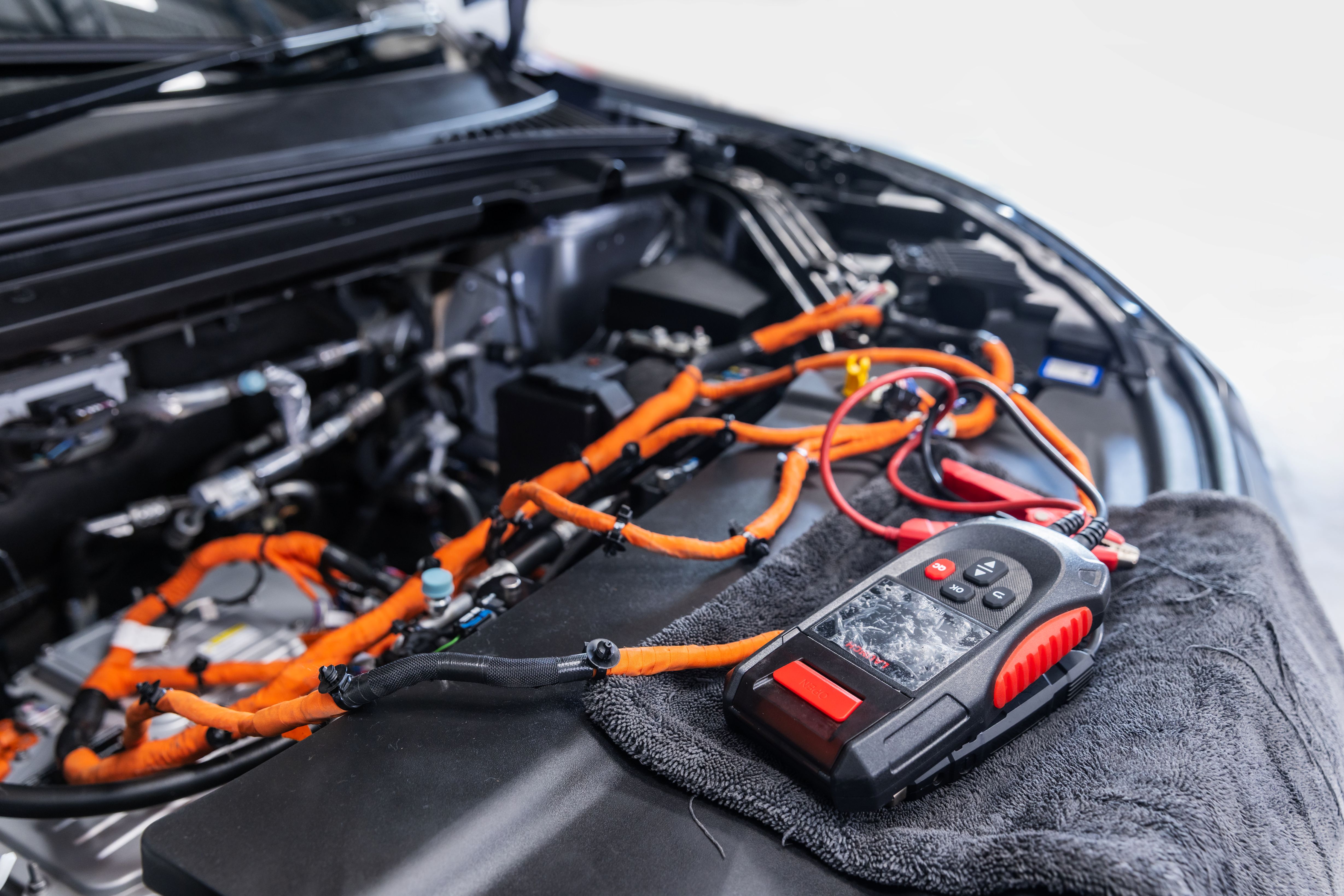
Overcoming the Challenges: A Hybrid Assessment Framework
To address these issues, BatteReverse proposes a multi-stage process that combines a dataset of heterogeneous data with a hybrid model based on a qualified, semi-empirical ageing model and machine learning tools for battery sorting. A score is calculated for each battery to estimate its secondary-market viability. This score is based on SoH and RUL estimation for different second-life applications.
Early-Stage Rapid Screening in Battery Reverse Logistics
The first stage of this process (see Fig. 1) is to collect data to identify the battery. This includes information on the battery's characteristics and history (i.e. from battery passport), as well as information from a basic inspection report (visual inspection), and basic safety check (electrical insulation). All of this information is entered into the BatteReverse’s Battery Data Space Platform.
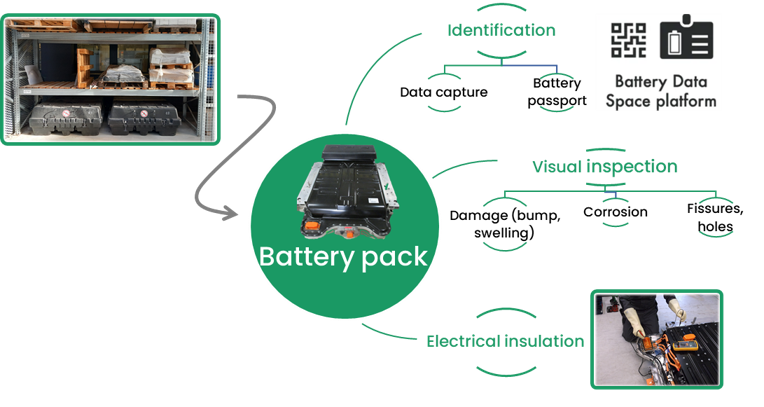
An initial sorting of batteries with defects or damage and electrical insulation problems can be carried out at this preliminary stage.
Enhancing Battery Data through Physical Characterisation at the Module Level
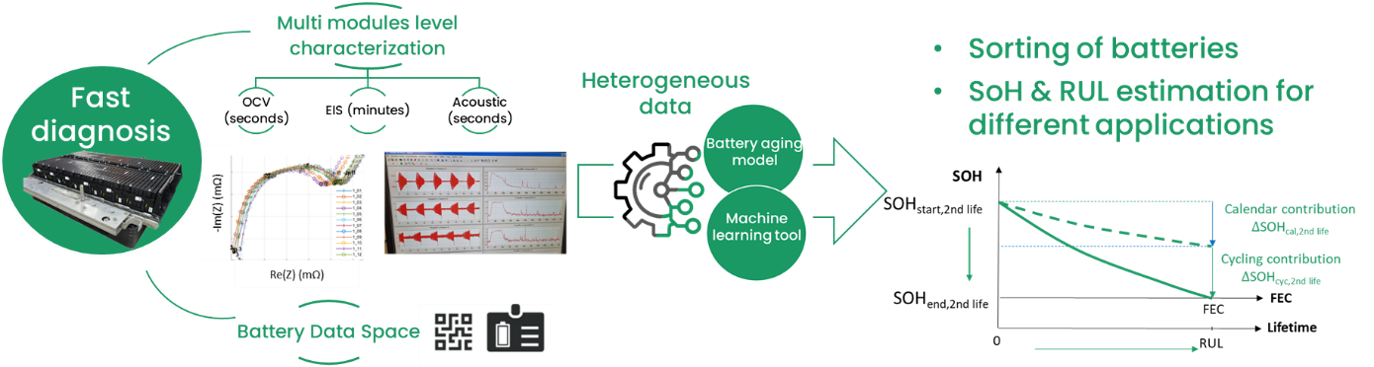
The second step consists of supplementing the data already collected in the BatteReverse Battery Data Space Platform with physical battery characterisation data. This data is obtained using fast diagnostic methods for battery packs with a granularity scale corresponding to the modules that comprise these packs.
The diagnostic methods evaluated during BatteReverse include the following:
- Measuring the cell voltage distribution at open circuit
- Performing electrochemical impedance spectroscopy (EIS) measurements between 5 kHz and 0.1 Hz
- Transmitting ultrasonic acoustic signals through the modules with a frequency sweep between 20 kHz and 100 kHz for 5 milliseconds
These experiments were complemented by measurements of internal direct current resistance and partial discharge at the module level during module or pack electrical testing.
Performance and durability evaluation on reduced battery set
The battery's performance in terms of SOH and durability was thoroughly evaluated on a representative reduced batch. A comprehensive set of characterisation tests was conducted at the individual module level to this end. Additionally, a selection of modules underwent ageing tests under various conditions, including calendar and cycling ageing.
AI-based analysis of battery diagnostic data for SoH and Remaining RUL estimation
It is challenging to identify the right indicators to assess batteries and guide them towards the most suitable recovery path, such as recycling, refurbishment, remanufacturing, or reuse in various applications. AI-based tools are particularly effective at handling highly heterogeneous data in terms of dimensions (scalar, vector, or matrix) and physical attributes. A part of BatteReverse’s work consisted of proposing innovative tools for fast sorting of battery modules. Such a tool requires the characterisation of targeted second-life applications and the capacity to estimate RUL for such applications. SOH estimation that reflects the current module state and RUL estimation mainly rely on ageing prediction of the module.
In order to avoid conventional and time-consuming SOH measurement methods, several machine learning regression approaches have been tested in BatteReverse (Support Vector Regression, Gaussian Process Regression, Multi-Layer Perceptron, etc.). BatteReverse achieved the implementation of the models, trained with the project’s module fast diagnostics data, reaching the expected precision for SOH approximation.
In complement, RUL prediction is performed by a simplified ageing model calibrated on dedicated calendar and cycling ageing tests.
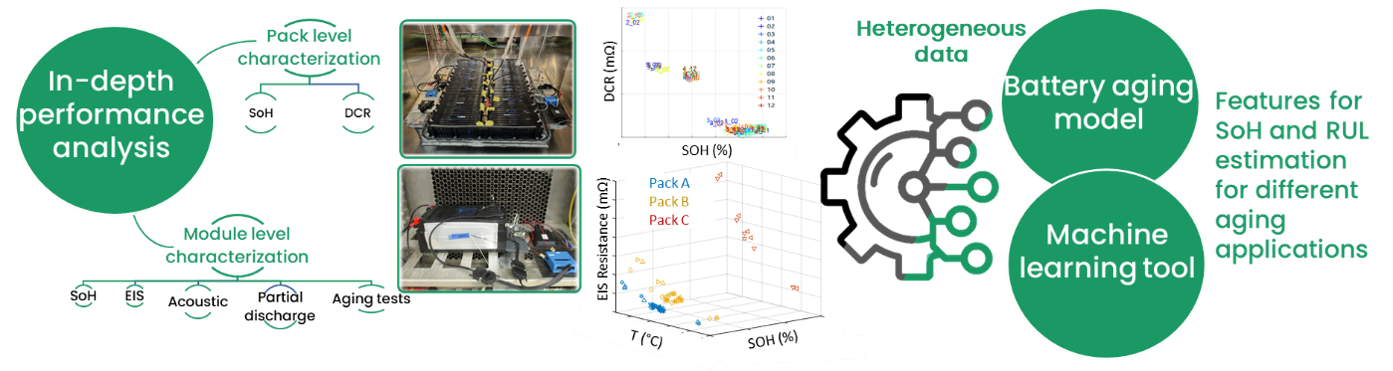
In an industrial perspective, a first integration in BatteReverse sorting tool combines: access to the BatteReverse Battery Data Space, SOH module estimation models, 2nd life applications RUL prediction. This tool offers a seamless decision support for the battery pack sorting process based on modules SoH and RUL estimations.
Key challenges for fast diagnosis and RUL prediction
The methodology of the BatteReverse project for estimating SoH and RULis a significant advancement for second-life battery applications. The methodology emphasises the need for effective diagnostic techniques and devices that can be integrated early in reverse logistics processes. This approach balances equipment costs, diagnosis duration, and estimation precision. Since machine learning algorithms require data from supervised learning phases, performance and durability tests have to be conducted on representative battery batches (used electric vehicle battery packs driven on European roads) according to a reference protocol. These reference tests enable evaluating battery ageing degradation rates for 2nd life usage and, by extending ageing tests duration, demonstrate battery operation to final state-of-health targeted at end of 2nd life by the repurposer. Furthermore, data collection relies on adapted data space infrastructure and interfaces to train and operate SoH and RUL prediction algorithms. This process enables the estimation of SoH and RUL indicators for various second-life applications, such as energy storage and backup power supplies, thus facilitating data-driven decisions for optimal next-use pathways, including recycling, refurbishment, or redeployment in high-value second-life applications.


